Why Choose Industrial Aluminum Profiles for Your Business?
Choosing the right structural material can affect a business long after installation. Industrial Aluminum Profiles offer a practical option for building machine frames, workstations, guards, and conveyor supports. Their combination of relatively low weight and useful strength can make equipment easier to handle and reposition. That matters. A lighter frame may also simplify assembly, though the result depends on the design and load requirements.
Profiles are available in different shapes and dimensions, allowing designers to build structures around specific equipment. T-slot designs, for example, can accept compatible brackets and fasteners, making adjustments possible without extensive welding. For a production line, this could mean moving a sensor mount or adding a support rail with common workshop tools. Small changes can save time. But compatibility is not automatic; slot size, connector type, and load capacity must match.
Industrial Aluminum Profiles also resist corrosion in many ordinary indoor environments, and their surfaces can be finished to suit different applications. Still, aluminum is not the right answer for every setting. Heavy loads, impact, heat, chemicals, and outdoor exposure may call for a careful material and finish review. A profile can look robust and still be poorly specified. That is worth remembering. Before selecting a system, businesses should check supplier technical data, design loads, joining methods, and maintenance needs. The best choice is not simply the lightest or cheapest one. It is the profile system that fits the work, supports safe operation, and remains practical to maintain.
What Industrial Aluminum Profiles Are
Why Choose Industrial Aluminum Profiles for Your Business?
What Industrial Aluminum Profiles Are
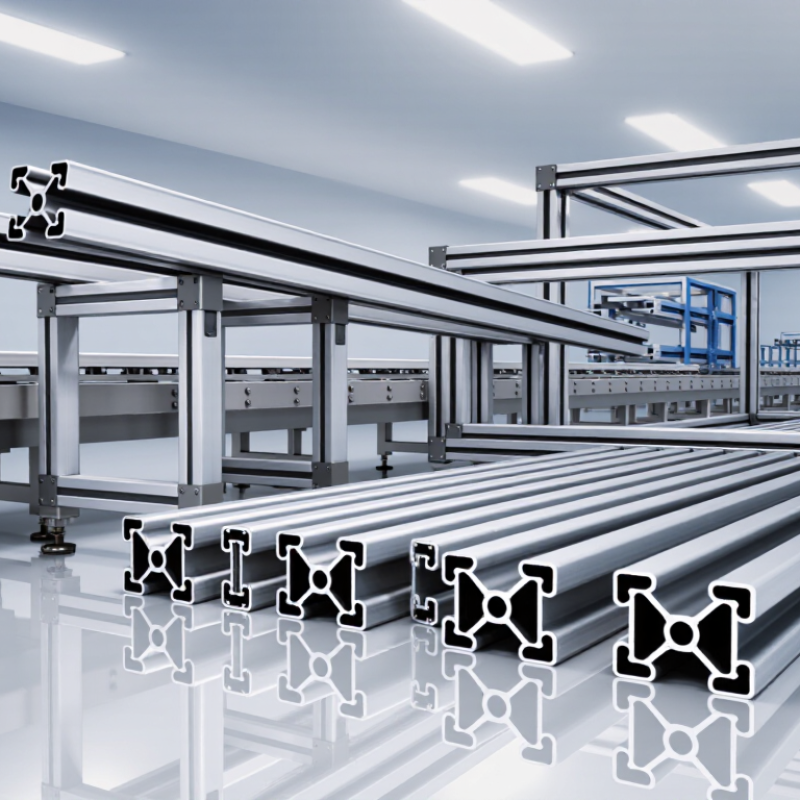
Industrial aluminum profiles are long, shaped sections made by pushing heated aluminum billet through a die. The die sets the cross-section: a T-slot, channel, angle, or hollow tube. Simple idea. Their geometry lets builders assemble frames, guards, workbenches, and conveyor supports without welding every joint. Alloy and temper matter. They affect strength, machinability, and corrosion behavior, so a catalog shape alone cannot confirm suitability.
The U.S. Geological Survey’s Mineral Commodity Summaries 2024 estimated world primary aluminum production at about 70 million metric tons in 2023. That figure describes the wider material supply, not profile output, but shows aluminum’s industrial scale.
On a factory floor, a T-slot profile can hold a sensor bracket, while a corner connector squares a machine enclosure. Assemblies can be adjusted when layouts change. Useful. But joints, deflection, vibration, and load paths still need checking; profiles are not automatically lighter or cheaper once brackets and fasteners are counted.
Specify alloy, temper, dimensions, tolerances, finish, and connection method against actual loads and conditions. For wet, abrasive, or hot environments, assess the complete assembly, not just the extrusion. One overlooked detail: slots collect dust and coolant, so plan access for cleaning before installation.
How Industrial Aluminum Profiles Are Designed and Made
Why Choose Industrial Aluminum Profiles for Your Business?
How Industrial Aluminum Profiles Are Designed and Made
Design starts with the job: expected loads, span, mounting points, and exposure to moisture or chemicals. Engineers select an alloy and shape the cross-section around those demands. Ribs can add stiffness; hollow chambers can reduce weight. Slots and grooves make assembly easier, but they also affect strength and die complexity. A perfect-looking section can still be inefficient to extrude. That trade-off deserves a second look. During production, a heated billet is pressed through a shaped steel die, then the profile is cooled, stretched, cut, and often heat-treated. Anodizing or powder coating may provide added surface protection.
Material choices matter, too. European Aluminium’s Environmental Profile Report (2018) states that recycling aluminium takes about 5% of the energy required to produce primary aluminium. This is useful context, not a guarantee that every profile has a low footprint; recycled content, processing, and transport all affect the result. Ask suppliers for alloy details, temper, dimensional tolerances, and relevant test records. Small details matter.
Tips: Share a clear load diagram and assembly drawing before requesting a quote. Test a short production run to check fit, deflection, and finish. A slot that looks convenient on screen may not work well with real fasteners.
Where Businesses Use Aluminum Profiles
Where Businesses Use Aluminum Profiles
Industrial aluminum profiles appear in production floors, warehouses, and commercial spaces. Their T-slots let teams attach brackets, panels, and accessories without welding. A technician can build a small inspection station beside a conveyor, then reposition its monitor arm when the workflow changes. Profiles also form machine frames, safety enclosures, tool racks, and adjustable workbenches. They are useful where layouts evolve. Still, modularity does not replace proper engineering.
Retailers use profiles for display frames and shelving, while equipment makers build lightweight supports and instrument stands. In factories, profiles can help organize cables and create partitions around work areas. Their surface resists corrosion in many indoor conditions, but moisture, chemicals, and outdoor exposure can affect material choice and finish. A frame may look sturdy yet flex under an uneven load. That detail is easy to miss.
Tips: Match profile size to the expected load and span. Check connectors, anchoring points, and panel weight before assembly. Measure twice. For moving equipment, account for vibration and repeated impacts. Ask for load data when available, and test a prototype under realistic conditions. It may take one revision. That is normal.
How to Choose Profiles for Business Needs
Choosing an industrial aluminum profile starts with the task, not the catalog. Define the load, span, movement, and working environment before comparing dimensions. A frame supporting a conveyor needs different stiffness from a lightweight inspection stand. Check deflection limits, joint loads, and whether cables or guards must fit inside the assembly. Small details matter.
Match the alloy and temper to the actual demands. Then compare slot size, wall thickness, machining needs, corrosion exposure, and surface finish. Ask suppliers for load tables and dimensional tolerances, not just a price per meter.
The International Aluminium Institute reports that recycling aluminum typically uses about 5% of the energy required for primary production; recycled content may therefore matter in a project’s environmental assessment.
The Aluminum Association also reports that nearly 75% of all aluminum ever produced remains in use, reflecting the material’s long service life.
Those figures do not guarantee a profile’s durability. Design and maintenance still count. A common mistake is choosing the cheapest section before checking connectors, cutting waste, and assembly time. That can backfire. Compare the full installed cost, and test a short assembly before ordering for the whole line. A little extra review helps.
 English
 Česká republika
 Deutsch
 Dutch
 Polska