Top Suspended LED Panel Suppliers for Global Buyers
Global buyers are rethinking commercial lighting as energy costs, carbon targets, and workplace standards become harder to ignore. The International Energy Agency identifies lighting efficiency as an important part of global energy-saving efforts. The U.S. Department of Energy also reports that LED products can use at least 75% less energy and last up to 25 times longer than incandescent lighting.
That shift explains the growing interest in Suspended Led Panel solutions. These fixtures combine direct illumination with a clean ceiling profile. In offices, schools, retail stores, and transport facilities, they can create evenly distributed light without crowding the ceiling. A well-designed installation feels calm. A poor one produces glare, dark corners, or distracting reflections on screens.
Supplier quality remains the difficult part. Product samples may look similar, yet their drivers, optical systems, heat management, and warranty support can differ considerably. Reports from organizations such as the U.S. Department of Energy, the International Commission on Illumination, and market research firms provide useful industry context, but they do not replace technical verification. Buyers should examine LM-79 or equivalent photometric data, color consistency, flicker performance, emergency options, and certification documents.
No supplier ranking is perfect. Project conditions vary too much. A low price may hide shorter component life or complicated installation. The most reliable comparison considers total ownership cost, documented performance, lead times, after-sales service, and regional compliance. This guide reviews leading Suspended Led Panel suppliers for global buyers, while recognizing that real-world performance still depends on specification, installation, and maintenance.
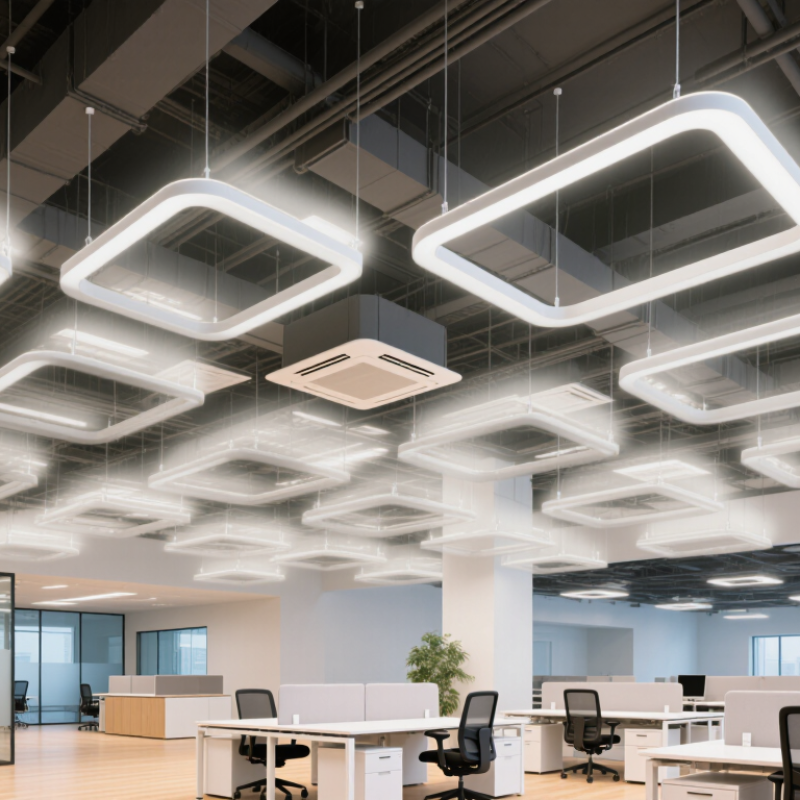
Understanding Suspended LED Panels and Their Main Applications
Top Suspended LED Panel Suppliers for Global Buyers
Suspended LED panels hang below the ceiling, creating broad, even illumination without bulky fixtures. Unlike recessed panels, they remain visible and become part of the interior design. Their slim housing can support direct lighting, indirect lighting, or both. The visible cable system also helps installers adjust mounting height during fit-out work. In offices, classrooms, reception areas, and retail spaces, these panels reduce harsh shadows across desks and walkways. However, poor spacing can create bright patches and uncomfortable glare.
Applications depend on ceiling height, task requirements, and visual atmosphere. Offices often need low-glare light for computer screens, while galleries may prefer softer output. Restaurants and hotels sometimes use suspended panels to define seating zones. Warehouses can use them in administrative areas, but high-bay fixtures may suit storage zones better. A reliable supplier should provide photometric data, color consistency details, driver information, and safety documentation. Specifications alone are not enough. Installation conditions still matter.
Tips: Check the suspension length before ordering. Confirm dimming compatibility with local control systems. Ask for a sample panel when color accuracy matters. Keep spare drivers available for large projects. A warm color temperature may feel comfortable, yet it can reduce visual sharpness. This trade-off is easy to overlook. Also, verify ceiling load limits and service access, because a beautiful installation becomes difficult when maintenance was not considered.
Key Factors for Evaluating Global LED Panel Suppliers
Choosing a suspended LED panel supplier requires more than comparing online prices. Global buyers should check product performance, factory capability, and communication quality. Request photometric files showing lumen output, beam angle, color temperature, and color rendering. A reliable supplier should also provide flicker data and tested lifetime estimates.
Certifications matter, but documents need careful review. Confirm that certificates match the exact panel model, not an older product. Ask for LM-80 or equivalent testing evidence when long operating life is important. Review warranty terms, replacement procedures, packaging strength, and spare-part availability. A supplier may promise fast delivery, yet production capacity should support that promise. Sample testing often reveals uneven brightness, loose suspension cables, or visible color differences. These small faults can become expensive across a large installation.
Top Suspended LED Panel Suppliers by Market and Product Strength
Top Suspended LED Panel Suppliers for Global Buyers
Top Suspended LED Panel Suppliers by Market and Product Strength
Suspended LED panel suppliers differ sharply by market and product capability. European projects often prioritize refined optics, low glare, and strict documentation. Buyers in North America may focus on modular sizing, dimming compatibility, and dependable replacement parts. Middle Eastern projects commonly require strong thermal performance and stable operation in warm interiors. Asian commercial spaces often value flexible layouts, quick delivery, and competitive pricing.
Product strength matters more than a polished catalogue. A capable supplier should provide tested light distribution data, color consistency records, installation drawings, and clear warranty terms. Ask for samples before approving large quantities. Check the cable suspension, ceiling fittings, driver quality, and emergency lighting options. These small details affect installation time. They also expose weak manufacturing control. A supplier may claim high efficiency, yet provide no independent test report. That should invite careful questions.
Tips: Match the supplier to the project market, not only the unit price. Request a sample panel, photometric files, spare-part guidance, and recent project references. Confirm lead times in writing. Review regional electrical requirements with a qualified professional. One practical mistake is judging brightness from photographs. Images hide glare, shadowing, and uneven color. Another is ignoring after-sales support. A panel can perform well for months, then become difficult to repair. Specifications sometimes look perfect. Real installation feedback may disagree.
Top Suspended LED Panel Suppliers for Global Buyers
Market Requirements and Product Strength Benchmarks
The chart compares common maintained-illuminance requirements with typical suspended LED panel efficacy targets across major application markets. Office and education projects generally require higher illuminance and glare control, while hospitality applications usually prioritize visual comfort, dimming flexibility, and warm color temperatures. Actual specifications should be confirmed against local lighting standards and project conditions.
Comparing Product Quality, Certifications, Pricing, and Support
Global buyers should judge suspended LED panel suppliers beyond catalog images. The U.S. Department of Energy reports that LED lighting can use at least 75% less energy and last up to 25 times longer than incandescent lighting. This benchmark supports long-term value, but panel quality still varies widely. Request LM-79 photometric reports, LM-80 data, TM-21 projections, and IEC 60598-1 safety compliance. Check measured efficacy, color consistency, flicker, thermal performance, and driver specifications. A bright sample can still fail after continuous use.
Certifications need careful verification. Look for applicable CE, UKCA, RoHS, and EMC documentation, with test reports matching the exact model and factory. The DesignLights Consortium’s Qualified Products List also provides a useful efficiency and performance reference for eligible commercial products. Yet certification alone is not proof of durability. Ask for production traceability, burn-in procedures, warranty terms, and independent laboratory records. Some suppliers provide polished documents but weak after-sales evidence.
Pricing should include the full landed cost. Compare panel price, suspension hardware, drivers, spare parts, shipping, duties, installation time, and replacement risk. The IEA has repeatedly identified efficient lighting as a major electricity-saving opportunity, so payback calculations should use local energy tariffs and operating hours. Support matters during installation. Require wiring diagrams, photometric files, dimming compatibility, and response-time commitments. My practical concern is simple: a low bid often hides integration work. Still, premium pricing does not guarantee perfection. Test a small batch first, measure light output onsite, and record failures honestly.
How to Select the Right Supplier for Your Project Needs
Top Suspended LED Panel Suppliers for Global Buyers
Selecting a suspended LED panel supplier requires more than comparing unit prices. The IEA reports that lighting consumes roughly 10% of global electricity, so efficiency affects long-term operating costs. Ask suppliers for measured efficacy, power-factor data, flicker results, and lifetime testing. Laboratory claims can look impressive. Verify them.
For office projects, request UGR data, especially for screens and open workstations. A supplier should explain whether the reported value follows EN 12464-1 methods. Check LM-80 and TM-21 documentation for LED maintenance claims, plus independent safety certificates for your target market. The U.S. Department of Energy’s solid-state lighting research reports that leading LED packages can exceed 200 lumens per watt under laboratory conditions. Finished panels usually deliver less. That difference matters.
Review driver quality, not only the panel housing. Confirm compatibility with DALI, 0–10 V, emergency controls, and local voltage requirements. Ask for a sample installed at the planned ceiling height. Look for glare, noise, uneven diffusion, and visible flicker. A clear warranty is useful, but response time matters more during a failed installation. Check spare-driver availability and packaging protection for long-distance shipping.
Do not accept every spreadsheet immediately. I have seen projects overvalue efficacy and underestimate installation labor. Compare five-year cost, replacement access, lead time, and documentation quality. A capable supplier shares test reports without hesitation. That is not proof of perfection, but it is a dependable starting point.
Top Suspended LED Panel Suppliers for Global Buyers - How to Select the Right Supplier for Your Project Needs
| Evaluation Dimension | Recommended Benchmark | Why It Matters | Documents or Evidence to Request |
|---|---|---|---|
| System Type | Suspended linear or panel lighting with adjustable suspension cables and ceiling accessories | Ensures the product is suitable for open ceilings, offices, retail spaces, schools, and commercial interiors | Product drawings, installation instructions, suspension-load information, and mounting details |
| Luminous Efficacy | Approximately 90–140 lm/W, depending on configuration and operating conditions | Higher efficacy can reduce installed wattage and long-term electricity consumption | LM-79 or equivalent photometric report, rated power, delivered lumens, and test conditions |
| Color Temperature | Common options: 3000K, 3500K, 4000K, 5000K, and 6500K | Allows the lighting design to match the visual and functional requirements of different spaces | CCT tolerance, chromaticity data, sample photos, and color-consistency information |
| Color Rendering Index | CRI ≥80 for general areas; CRI ≥90 for retail, hospitality, healthcare, and design-focused applications | Improves the visual appearance and color recognition of objects and finishes | LM-79 report, CRI data, R9 value where relevant, and spectral information |
| Glare Control | UGR <19 for many office and computer-based workspaces, subject to the complete lighting layout | Helps limit discomfort glare and supports visual comfort in occupied areas | UGR calculation, photometric file such as IES or LDT, diffuser specification, and lighting simulation |
| Flicker Performance | Low-flicker or flicker-free driver option with documented performance | Supports visual comfort and can be important in workplaces, studios, and camera-monitored environments | Flicker percentage, flicker index, modulation data, or applicable test report |
| Dimming and Controls | 0–10 V, DALI, phase dimming, occupancy sensing, or daylight harvesting as required | Provides energy-saving and scene-control options for modern building systems | Wiring diagrams, control compatibility list, dimming range, and commissioning guidance |
| Rated Lifetime | Typically 50,000–100,000 operating hours as a declared LED-system rating | A longer rated life may reduce relamping frequency and maintenance costs | LM-80 data, TM-21 projection, L70 or L80 rating, and driver-life information |
| Warranty | A clearly defined 3–5 year commercial warranty, with longer terms evaluated case by case | Clarifies the supplier’s responsibility for product defects and early failures | Warranty certificate, exclusions, claim procedure, labor coverage, and replacement policy |
| Safety and Compliance | Compliance with the electrical and safety requirements of the destination market | Reduces approval, insurance, installation, and regulatory risks | Applicable safety test reports, declarations of conformity, EMC reports, and market-specific approvals |
| Ingress Protection | IP20 for dry indoor spaces; IP44 or higher where additional protection is required | Helps match the luminaire to dust, moisture, and cleaning conditions | IP test report, installation restrictions, sealing details, and maintenance instructions |
| Emergency Lighting | Optional emergency battery pack or central-emergency compatibility where required by code | Supports safe evacuation and project compliance during power interruptions | Emergency duration, battery type, testing method, photometric data, and applicable certification |
| Customization Capability | Custom lengths, finishes, optics, suspension kits, connectors, and control options | Makes it easier to coordinate the lighting system with the architectural and electrical design | Engineering drawings, sample approval process, minimum order quantity, and tooling charges |
| Supply Capacity | Demonstrated ability to produce the required quantity with consistent specifications | Reduces the risk of inconsistent color, finish, performance, or delivery between production batches | Production schedule, quality-control plan, batch traceability, and representative project references |
| Lead Time | Confirm manufacturing, approval, shipping, and contingency time before placing the order | A realistic schedule helps coordinate ceiling work, electrical installation, and project handover | Written production timeline, shipping terms, packaging plan, and escalation contact |
| Total Cost of Ownership | Compare product price, installation, controls, freight, energy use, maintenance, and replacement costs | The lowest purchase price may not provide the lowest lifetime project cost | Itemized quotation, energy calculation, spare-parts pricing, maintenance assumptions, and payment terms |
Note: Performance ranges are general project benchmarks. Final requirements should be confirmed against local building codes, lighting calculations, installation conditions, and independently verifiable test documentation.
English
Česká republika
Deutsch
Dutch
Polska