China Top Excavator Gear Manufacturers?
China has become an important sourcing base for excavator gear components, from travel-drive gears to swing-drive assemblies. Yet “top” depends on the machine, operating conditions, and support required. A gear that performs well in a compact excavator may not suit a heavy machine working long shifts in abrasive soil. Details matter.
This guide examines Chinese manufacturers through practical criteria: product range, gear accuracy, material control, heat treatment, inspection records, and delivery support. Buyers should ask how a supplier verifies tooth profiles, manages hardness across the gear, and handles wear or noise complaints. A polished catalog helps. It proves little by itself. Sample parts, clear specifications, and consistent documentation offer stronger evidence, though even these deserve careful review.
Mechanical-design author Robert L. Norton offers a useful engineering lens. A fair paraphrase of his machine-design approach is: “Assess gears by their loads, materials, lubrication, and failure risks—not by catalog claims alone.” This is a paraphrase, not a verbatim quotation. Applied to excavator gear sourcing, it shifts attention from headline price to service life and operating fit. No checklist guarantees a perfect supplier. That is worth remembering. The following overview helps readers compare manufacturers, identify questions for technical teams, and spot claims that need verification before a purchase decision.
What Excavator Gears Are and How They Work
China Top Excavator Gear Manufacturers?
What Excavator Gears Are and How They Work
Excavator gears transmit and modify rotation inside travel drives and swing drives. The engine usually powers hydraulic pumps, while hydraulic motors turn the gear assemblies. In a travel drive, a planetary reduction set uses a sun gear, several planet gears, and a ring gear. Their arrangement reduces rotational speed and increases torque, helping the tracks move a heavy machine across uneven ground. The swing drive uses a similar principle to rotate the upper structure. Small parts matter. A worn tooth can affect how smoothly the system moves.
Gear teeth must mesh with consistent contact and receive suitable lubrication. During maintenance, technicians check the specified oil level and look for metallic particles, unusual noise, or excess heat. These clues can point to wear, though they do not identify every fault by themselves. Dirt entering a housing or oil breaking down can accelerate damage. It is easy to focus only on the largest gear, but bearings, seals, and alignment also influence performance. In practice, gear wear is not always obvious from sound alone; inspection and service records help build a clearer picture.
Types of Gears Used in Excavators
Excavators rely on several gear types, each handling a different load path. Spur gears are simple and robust, but their straight teeth can create more noise under heavy loads. Helical gears engage gradually, making them useful where smoother, quieter transmission matters. Bevel gears redirect torque between intersecting shafts, while planetary sets pack high reduction ratios into compact swing drives and travel motors. Compactness matters. A planetary gearbox can place multiple load-sharing gears around a central sun gear.
Gear selection is not just about tooth shape. ISO 6336 evaluates gear capacity against both tooth-root bending and surface contact stress; both matter when an excavator repeatedly digs, slews, and climbs. AGMA 925-A03 also addresses how lubricant condition affects gear wear and micropitting. In practice, muddy work and heat make sealing and oil maintenance just as important as the gear design. A chipped tooth may be the obvious failure, but contaminated oil can quietly accelerate damage. There is a catch: real duty cycles vary, so catalogue ratings alone may not predict service life. Check the load, speed, shock, and lubrication data for the actual machine.
China’s Excavator Gear Manufacturing Industry
China’s excavator gear manufacturing industry serves a market shaped by large domestic demand and exports. The China Construction Machinery Association reported 201,131 excavator sales in 2024. Domestic sales reached 100,543 units, while exports totaled 100,588. These figures indicate a substantial equipment market, but they do not measure gear production directly. That distinction matters.
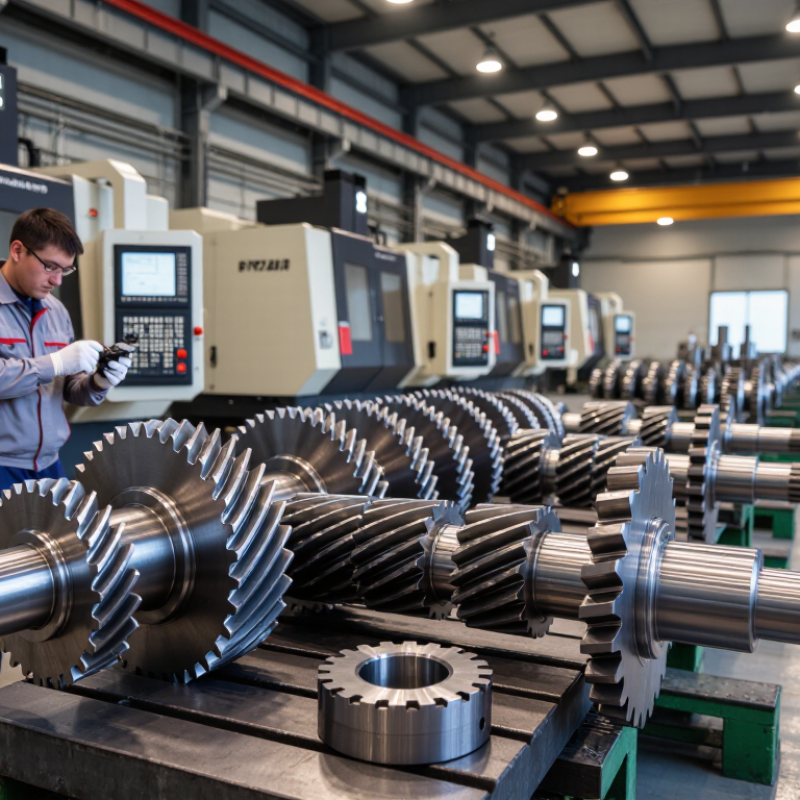
Manufacturers produce transmission gears, swing-drive gears, and travel-drive components, often from alloy steel. Cutting, heat treatment, grinding, and dimensional inspection all affect service life. The National Bureau of Statistics reported crude steel output of about 1.005 billion tonnes in 2024. This signals broad material capacity, not guaranteed availability of gear-grade steel. Small details matter. Tooth-surface hardness, runout, and noise checks can reveal problems before assembly. Yet inspection records may not capture every variable in heat treatment. A polished gear can still wear early if lubrication or alignment is poor. Buyers should compare material certificates, process controls, and test results—not just production capacity. Some supplier data remains hard to compare consistently. That is an industry weakness worth acknowledging.
China’s Excavator Gear Manufacturing Industry
Excavator sales provide a market-demand proxy for components such as gears; these figures represent machine sales, not gear production.
Annual excavator sales in units. Source: China Construction Machinery Association (CCMA) industry sales statistics.
Leading Chinese Excavator Gear Manufacturers and Their Products
Chinese excavator gear manufacturers supply components for travel drives, swing drives, and transmission systems. Common products include planetary gears, ring gears, sun gears, pinions, shafts, and complete reduction assemblies. Some factories handle machining, heat treatment, and inspection in-house. Others focus on particular gear types or custom production. The right supplier depends on the machine model, operating load, and required service life.
Material and processing choices matter. Alloy steel gears may be carburized or induction-hardened, depending on their design and duty cycle. Buyers should check tooth accuracy, hardness records, gear-contact patterns, and dimensional reports. Ask whether samples can be tested under realistic loads. A polished catalog is not enough. Details such as backlash and surface finish can affect noise, heat, and wear in the field.
For a practical comparison, review production capacity, quality-control steps, replacement-part availability, and technical support. Request drawings and confirm that dimensions match the existing assembly before ordering. A lower price may be useful, but only when inspection and traceability are clear. I would still treat supplier claims cautiously; a factory visit or independent sample check can reveal gaps that paperwork misses.
How to Evaluate and Choose an Excavator Gear Manufacturer
China Top Excavator Gear Manufacturers?
How to Evaluate and Choose an Excavator Gear Manufacturer
Choosing an excavator gear manufacturer takes more than comparing prices. Start with the gear’s exact application, dimensions, material, and operating load. Ask how the supplier controls tooth accuracy, heat treatment, and final inspection. These details affect noise, wear, and fit during installation. Request inspection records and material specifications for the parts you plan to buy. Clear documentation makes comparisons more reliable.
Check whether the manufacturer can explain its production process and respond to technical questions with specific answers. Ask about tolerances, surface hardness, lead times, and procedures for handling defects. A sample gear or dimensional report can reveal gaps before a larger order. Look closely at tooth finish and measurement consistency. A polished brochure is not enough. One detail is easy to overlook: confirm that drawings use the same units and revision as your equipment. Even experienced buyers can miss this.
Tips: Share operating conditions, photos, and verified measurements before requesting a quote. Compare warranty terms and communication quality, not just unit cost. If a specification is unclear, pause and ask. A small delay now may prevent an expensive mismatch later. And keep the evaluation practical: suppliers may not meet every preference, so identify which quality checks matter most for your machine.
China Top Excavator Gear Manufacturers? - How to Evaluate and Choose an Excavator Gear Manufacturer
| Evaluation Area | What to Evaluate | Evidence to Request | Practical Selection Check |
|---|---|---|---|
| Drawing and specification control | Ability to work to the current approved drawing, including tooth geometry, dimensions, tolerances, and revision status. | A controlled drawing review, revision record, and written confirmation of the applicable specifications. | Ask the supplier to identify critical-to-function dimensions and explain how changes are approved and recorded. |
| Material traceability | Whether the gear material matches the specified grade and can be traced from incoming stock to the finished part. | Material test certificates, heat or batch identification, and records linking the material batch to production lots. | Check that certificates identify the material and batch and can be matched to the parts being supplied. |
| Heat-treatment control | Control of the specified heat-treatment process and resulting properties, such as hardness and case depth when required by the drawing. | Process records and inspection results measured against the part specification, including the measurement method and sampling plan. | Confirm that test locations and acceptance limits follow the drawing or agreed inspection plan; do not rely on a generic hardness claim. |
| Tooth accuracy and inspection | Inspection of relevant gear characteristics, such as profile, lead, pitch, runout, and backlash where specified. | Inspection reports with actual results, specified tolerances, equipment identification, and calibration status. ISO 1328-1 may be relevant to cylindrical gear accuracy when applicable to the design. | Verify that the report covers the gear type and characteristics required by the drawing, rather than presenting an unrelated accuracy certificate. |
| Manufacturing process capability | Whether the supplier has suitable processes for the specified gear, including machining, gear cutting, finishing, and any required heat treatment. | A process flow, equipment list relevant to the part, and examples of in-process and final inspection records. | Ask how the supplier controls key process steps and handles nonconforming parts before shipment. |
| Application understanding | Understanding of the gear’s position in the assembly, operating loads, duty cycle, lubrication, and environmental conditions. | A technical review that identifies missing inputs and confirms assumptions before production begins. | Check that the supplier asks about operating conditions instead of selecting a replacement solely by external dimensions. |
| Prototype and first-article approval | A defined process for validating a new or revised part before routine production. | First-article inspection results, sample approval records, and agreed criteria for functional testing where applicable. | Agree in writing which measurements and assembly or operating checks are required before approving volume orders. |
| Quality management and corrective action | A documented system for inspection, lot identification, nonconformance handling, and corrective action. | Relevant quality-system certification where available, sample control records, and an example of a corrective-action report with sensitive details removed. | Evaluate whether corrective actions identify causes and prevention measures, not only replacement of the affected parts. |
| Delivery and supply continuity | Quoted lead time, production capacity for the requested order pattern, packaging, and communication of schedule changes. | A written production and delivery schedule, packaging specification, and shipment documentation plan. | Compare committed dates and order assumptions, including tooling, sample approval, and repeat-order lead times. |
| Commercial terms and after-sales support | Clarity of pricing, minimum order quantities, payment terms, warranty scope, and technical support responsibilities. | A written quotation and warranty terms that define coverage, exclusions, claim evidence, and response process. | Compare total purchasing requirements and claim procedures, not only the unit price. |
English
Česká republika
Deutsch
Dutch
Polska