 English
 Česká republika
 Deutsch
 Dutch
 Polska



What Are the Top 10 Types of Small CNC Machines?
A small CNC machine can turn a garage bench, a school lab, or a compact production cell into a precise workspace. But “small” does not mean simple. A desktop router cuts wood and plastics; a benchtop mill handles metals; a compact lathe makes cylindrical parts. Each machine trades work envelope, rigidity, speed, and cost differently. The right choice depends on the part, material, tolerance, and available floor space.
The scale of the wider market is significant. Grand View Research estimated the global CNC machine market at USD 101.22 billion in 2023, with projected growth through 2030. That figure covers CNC machines broadly, not small models alone. It signals investment in automated machining, but it cannot tell a buyer which compact machine will suit a particular shop. A market report is not a machine test.
Details matter. A steel bracket can expose a light mill’s lack of rigidity. A small engraved panel may need only a precise router and a dust shoe. W. Edwards Deming, a leading quality-management expert, is associated with the reminder, “Quality is everyone’s responsibility.” For a small CNC machine, that means considering setup, tooling, workholding, and operator skill alongside specifications. Some claims deserve a closer look. A larger spindle rating does not guarantee better cuts. This guide compares ten common small CNC machine types, focusing on what each can make, where it fits, and what compromises to expect.
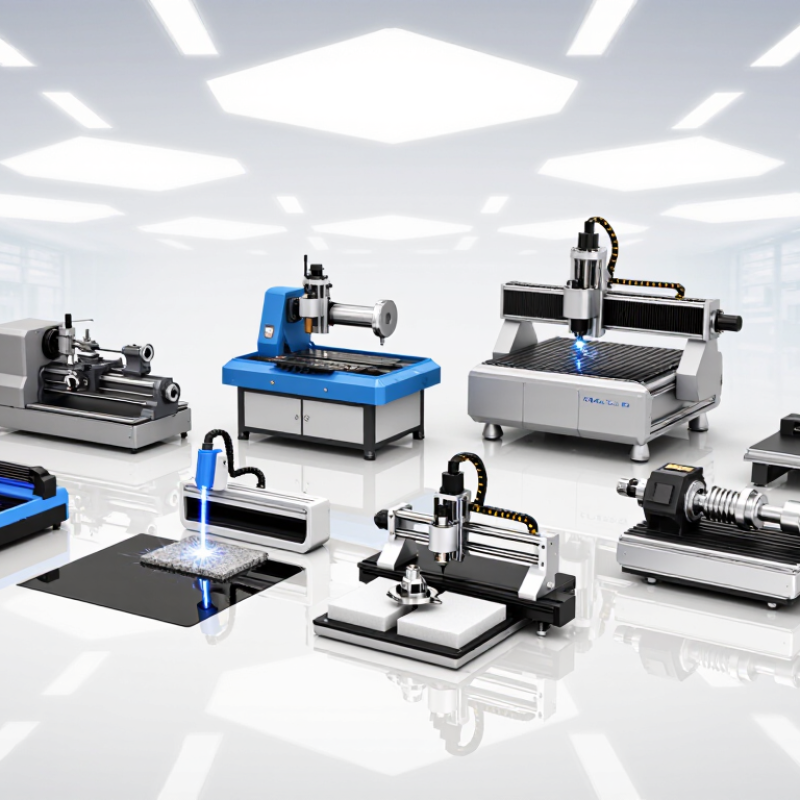
How Small CNC Machines Are Classified by Motion and Machining Process
What Are the Top 10 Types of Small CNC Machines?
How Small CNC Machines Are Classified by Motion and Machining Process
Small CNC machines can be grouped by motion and by machining process. These labels describe different things. Motion refers to the axes available and how the cutter or workpiece travels. A compact three-axis mill moves along X, Y, and Z, making flat pockets, slots, and drilled patterns. Add a rotary axis, and the machine can turn cylindrical parts. More axes allow angled features, but setup and programming become harder. That matters.
Process describes how material is shaped. Mills use a rotating cutter; CNC lathes rotate the workpiece against a tool. Routers handle sheet goods and softer materials with a spinning bit. Laser machines cut or mark without a contacting cutter. Plasma systems cut conductive sheet metal, while engravers focus on shallow text or surface details. These categories overlap. A small router with a rotary attachment combines a familiar process with extra motion. Size alone tells little. Spindle power, rigidity, work envelope, and tool access all affect achievable accuracy.
Tips: Match motion to geometry before comparing machine size. Three axes may suit a flat nameplate; curved sides may need rotary motion. Check sample cuts in your material, inspect the edge finish, and leave room for clamps. Clamp clearance is easy to overlook, and it can reduce usable travel.
What Are the Top 10 Types of Small CNC Machines? - How Small CNC Machines Are Classified by Motion and Machining Process
| Machine type | Motion and axes | Machining process | Typical work | Common materials | Best suited for |
|---|---|---|---|---|---|
| 3-axis CNC milling machine | Linear X, Y, and Z movement; the workpiece is usually fixed during cutting. | Rotating-tool milling, drilling, and boring. | Flat faces, pockets, slots, holes, and simple 3D contours. | Aluminum, plastics, brass, and steel within the machine’s capacity. | General-purpose parts and introductory CNC machining. |
| 4-axis CNC milling machine | Three linear axes plus one rotary axis, commonly used to index or rotate the workpiece. | Milling and drilling around multiple sides of a part. | Side features, radial holes, and parts that need machining at several angles. | Metals, engineering plastics, and machinable composites. | Reducing manual repositioning for parts with features around a central axis. |
| 5-axis CNC milling machine | Three linear axes and two rotary axes; the tool or workpiece can tilt and rotate. | Multi-angle milling, drilling, and complex surface machining. | Contoured parts, angled features, and components with several faces to machine. | Aluminum, steel, titanium, plastics, and other machine-compatible materials. | Complex geometry and fewer setups; programming and machine cost are typically higher than for 3-axis equipment. |
| CNC router | Usually three linear axes, often with a moving gantry and a fixed or moving table. | High-speed routing, profiling, pocketing, and engraving with a rotating cutter. | Panels, signs, cabinetry parts, patterns, and sheet profiles. | Wood, MDF, plastics, foam, and some non-ferrous metals when appropriately equipped. | Sheet and plate work where a relatively large cutting area and fast material removal are useful. |
| CNC lathe | The workpiece rotates around the spindle axis while the cutting tool moves along linear axes. | Turning, facing, boring, threading, and grooving. | Shafts, bushings, pins, and other mainly cylindrical parts. | Aluminum, brass, steel, plastics, and other materials suitable for turning. | Accurate round parts made from bar stock or individual blanks. |
| CNC mill-turn machine | A rotating spindle and turning axes are combined with driven milling tools; axis count varies by configuration. | Turning plus milling, drilling, and sometimes off-center machining in one setup. | Parts with both cylindrical surfaces and milled features, such as flats or cross-holes. | Metals and engineering plastics compatible with the tooling and machine setup. | Combining operations and reducing transfers between a lathe and a mill. |
| Swiss-type CNC lathe | Bar stock feeds through a guide bushing; the cutting zone is close to the support, with additional axes depending on the machine. | Precision turning, with milling or cross-drilling possible on equipped models. | Small-diameter, long, slender, or detailed parts produced from bar stock. | Stainless steel, brass, aluminum, and other machinable bar materials. | Small precision components where support near the cutting tool helps control deflection. |
| CNC plasma cutting machine | Typically two-dimensional X–Y motion; a Z axis may control torch height. | Thermal cutting with an electrically conductive plasma arc. | Profiles, brackets, and cutouts from flat metal sheet or plate. | Electrically conductive metals, including mild steel, stainless steel, and aluminum. | Fast metal profiling; it is not intended for wood, plastic, or other nonconductive materials. |
| CNC laser cutting machine | Usually two-dimensional X–Y motion, with Z-height control or a focus axis on some systems. | Focused laser cutting, marking, or engraving; suitable materials depend on the laser type and configuration. | Fine profiles, small openings, labels, and engraved patterns. | Depending on the system: metals, wood, paper, acrylic, or other approved materials. | Detailed cutting or marking with a narrow kerf; material compatibility and ventilation requirements must be checked. |
| CNC waterjet cutting machine | Usually two-dimensional X–Y motion; optional axes can tilt the cutting head. | A high-pressure water stream, often mixed with abrasive for cutting hard materials. | Flat profiles and cutouts from sheet or plate without a heat-based cutting process. | Metals, stone, glass, ceramics, and composites, subject to material and process limits. | Cutting heat-sensitive or varied materials; requires high-pressure equipment and water management. |
Note: “Small” describes a broad range of compact or benchtop equipment, not a standardized machine size. Work envelope, cutting capacity, axis configuration, and material limits vary by machine design.
FAQS
Lasers work well on thin sheet, acrylic, and wood. They create narrow cuts and fine details. Check fume extraction.
Plasma cuts conductive metals such as steel and aluminum. Edges may be rough, with slag left behind. Test a sample first.
It avoids heat damage, which helps when parts might distort. The setup needs space for a tank and abrasive handling. Cleanup can be easy to underestimate.
No. Industry-wide figures do not show how well a small machine performs. Compare usable work area, material limits, and sample cuts.
EDM can form intricate features in hard, conductive metals. Material removal is slower, and the dielectric-fluid setup needs care. Small parts matter.
A sharp bit, low spindle runout, and dust extraction help protect fine copper traces. Poor setup can spoil them quickly.
No. Engravers make lettering and shallow patterns. Grinders refine surfaces or tool edges, but require careful workholding and wheel dressing.
Vibration, dust, and weak fixturing can undermine precision. Advertised resolution does not tell the whole story. I would check the frame and tooling, too.