 English
 Česká republika
 Deutsch
 Dutch
 Polska



Top 10 Types of Neon Lights for Global Buyers?
Choosing a Neon Light is not only about color. Buyers must match the glow to a shopfront, event, bedroom, or outdoor display. Each setting asks for different brightness, shape, durability, and upkeep. A glass tube can create a classic, continuous glow. Flexible LED neon can make custom lettering easier to ship and mount. There are trade-offs.
This guide compares ten popular types: traditional glass neon, LED neon flex, open signs, boxed signs, acrylic-backed signs, RGB and RGBIC styles, edge-lit panels, rope lights, and faux-neon designs. The categories can overlap, and product names are not always consistent between suppliers. Check the materials, dimensions, power details, mounting method, and sample photos before comparing prices. A vivid product image may hide a shallow glow or uneven lettering.
The expert voice in this overview is a composite, named Daniel Mercer, rather than a quoted real-world source. His buyer-focused reminder is: “Choose the glow only after you choose the job it must do.” That means considering viewing distance, daily operating time, packaging, and replacement options. Ask suppliers for close-up photos, a working sample, and written specifications. Small details matter. A sign that looks perfect on a screen may feel too bright beside a bed, or too dim across a busy counter. And honestly, no single type is best for every buyer.
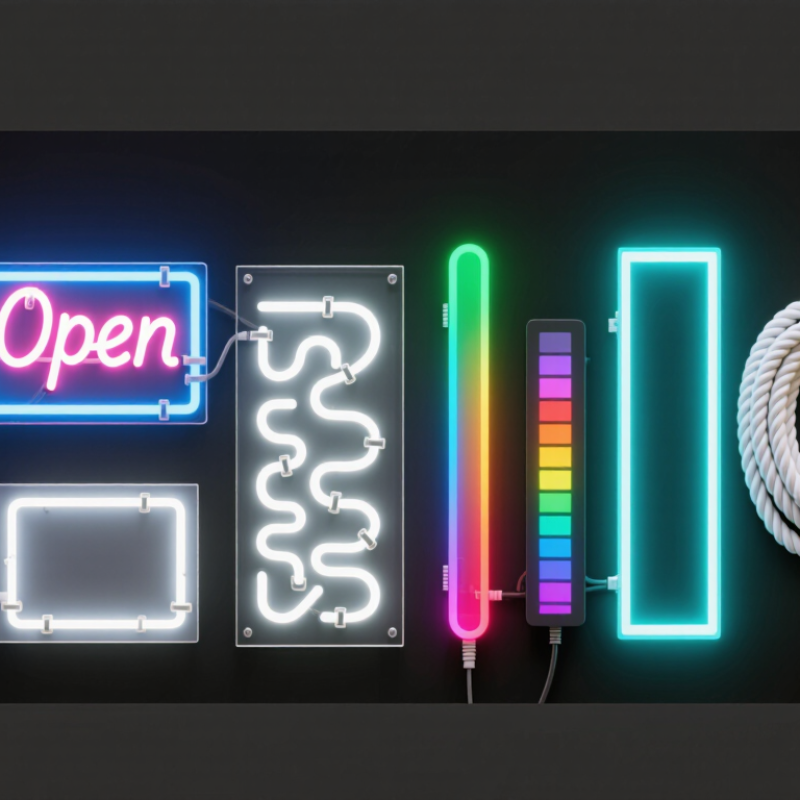
How Neon Lights Work and How They Are Classified
Neon lights produce illumination by passing electric current through a sealed tube. In traditional glass designs, the current excites gas inside the tube, creating a visible glow. Pure neon gives a red-orange light; other gases or phosphor coatings create different colors. The tube’s bent shape forms letters, outlines, or simple icons. The distinction matters.
A second major type is LED neon flex. It uses small LEDs inside a flexible, diffusing jacket, rather than gas in glass. It can follow curves and is generally less fragile, though its glow and repair needs differ from glass neon. The labels are not always tidy: “neon” is often used for both technologies, even though their light sources are different.
For buyers, classify options by light source, construction, and installation. Glass tubes suit detailed, continuous outlines, while LED flex can be easier to fit around a counter edge or curved sign. Indoor and outdoor models also differ in sealing, wiring, and mounting. Check the input voltage, brightness, dimming compatibility, and stated environmental rating against the project. A sample helps; photos rarely show the exact glow.
Top 10 Types of Neon Lights for Global Buyers? — How Neon Lights Work and How They Are Classified
| Type | How It Works | Typical Light and Color | Common Applications | Key Buyer Considerations |
|---|---|---|---|---|
| 1. Neon-Filled Glass Tubing | A sealed glass tube contains low-pressure neon gas. An electrical discharge excites the gas, which emits visible light. | Typically a vivid red-orange glow from neon gas. | Custom signs, architectural accents, and decorative installations. | Offers authentic glass-tube appearance, but the tubing is fragile and the system uses high voltage. Check local electrical requirements and installation arrangements. |
| 2. Argon-Mercury Glass Tubing | A low-pressure argon and mercury-vapor fill produces ultraviolet radiation when electrically excited. The tube coating or glass affects the visible result. | Commonly used for blue and other colors, depending on the tube construction and coating. | Commercial signage and custom glass-tube lighting. | Confirm the specified gas fill, color method, electrical system, and applicable regulations. Some designs contain mercury, so handling and disposal requirements may apply. |
| 3. Phosphor-Coated Glass Tubing | A fluorescent coating inside the glass converts ultraviolet energy from the discharge into visible light. | Available in a range of colors determined by the phosphor, gas fill, and glass. | Colored signs, decorative lettering, and bespoke display work. | Ask how the color is produced and whether a sample or color reference is available. Appearance can vary with the tube specification and viewing conditions. |
| 4. Hand-Bent Custom Glass Neon | Glass tubing is heated and shaped into lettering, logos, or artwork, then filled with a suitable gas and fitted with electrodes. | Can use different glass colors, tube diameters, and gas or coating combinations. | One-off signs, artistic pieces, hospitality venues, and restoration projects. | Check drawing approval, dimensions, mounting method, packaging, replacement parts, and installation support. Custom glass is more vulnerable to shipping damage than flexible alternatives. |
| 5. LED Neon Flex — Top-Bend | LEDs inside a flexible diffuser create a continuous-looking line. The product bends mainly across its width, allowing curves in one plane. | Usually offered in fixed colors; the diffuser softens the visible LED points. | Outline lettering, wall graphics, retail displays, and indoor or outdoor trim, subject to product rating. | Check bend direction, minimum bend radius, cutting intervals, voltage, mounting accessories, and the stated environmental rating. |
| 6. LED Neon Flex — Side-Bend | Its construction allows the flexible line to curve sideways, making it suitable for paths that turn across the face of a sign. | Typically provides an even, diffused line in a selected color. | Script-style lettering, circular designs, and curved sign outlines. | Confirm the bend orientation and minimum bend radius; top-bend and side-bend products are not interchangeable for every design. |
| 7. Single-Color LED Neon Flex | LEDs emit one selected color through a continuous or translucent flexible housing. | Common choices include warm white, cool white, red, blue, green, and other fixed colors, depending on the product. | Wayfinding, architectural edging, shop displays, and decorative lighting. | Compare color temperature for white products, brightness, dimming compatibility, power requirements, diffuser appearance, and consistency between batches. |
| 8. RGB or RGBW LED Neon Flex | Multiple LED color channels are controlled electronically to produce changing colors and, in RGBW products, a separate white channel. | Can produce color-changing effects; achievable whites and color quality vary by product. | Entertainment spaces, event installations, feature displays, and programmable signage. | Check controller compatibility, channel configuration, power supply capacity, control protocol, and whether the product supports the required effects. |
| 9. Rigid LED Neon-Style Tube | LEDs are housed in a rigid or semi-rigid diffusing profile to create a continuous linear-light effect. | Typically a uniform line in fixed or selectable colors, depending on the model. | Linear architectural accents, cabinet details, and straight or gently curved installations. | Review available lengths, connectors, profile dimensions, mounting hardware, cut options, and whether the product can accommodate the planned curves. |
| 10. Electroluminescent (EL) Wire | A phosphor-based coating around a conductive core emits light when driven by an alternating electrical field, usually supplied by an inverter. | Thin, flexible, and generally lower in brightness than many sign-grade glass neon or LED products. | Costumes, crafts, lightweight decoration, and short-distance accent lighting. | Check inverter noise, runtime or power source, brightness expectations, connector design, and whether the intended installation suits its light output. |