7 Tire Balance Bead Tips for Global Buyers

Buying a Tire Balance Bead for a global fleet involves more than comparing prices. Buyers must check bead material, size range, packaging, and compatibility with each tire and wheel assembly. A sample pouch, a clear product specification, and installation guidance can reveal more than a polished sales sheet. Small details matter.

For transparency, Evan Brooks is a fictional composite tire-balance specialist, not a verified industry source. His illustrative line for this guide is: “Match the bead to the tire, then verify the fit before scaling the order.” Treat that as editorial guidance, not a sourced quotation. Actual product decisions should rely on documented specifications and qualified technical review.

The seven tips ahead cover supplier checks, performance claims, shipping, and quality control. Ask for batch traceability and test information. Check how the beads are packed; a torn bag can complicate receiving and storage. Compare supplier answers against your own tire sizes and operating conditions. Do not assume one product suits every vehicle. That shortcut can be costly. Global sourcing also brings practical uncertainties, including long lead times and inconsistent documentation. This guide cannot resolve every application question, and some checks take time. That is worth admitting. A careful buyer keeps records, requests clarification, and reviews a small trial order before committing to larger volumes.
7 Tire Balance Bead Tips for Global Buyers

Understanding How Tire Balance Beads Work

Inside a tire, balance beads are small, free-moving particles placed within the tire cavity. Once the wheel spins, centrifugal force moves them around the inner surface. They tend to gather near lighter areas, helping counteract heavier spots in the tire-and-wheel assembly. The aim is smoother rotation, not a fixed weight attached to one point. At low speeds or while stopped, the beads may settle differently. That sounds simple, but it is not magic.

The bead quantity and type should match the tire size and the product’s installation guidance. Too few may not provide the intended correction, while an unsuitable amount can create problems. A careful installer also checks the tire’s condition, valve setup, and fit before adding anything. If vibration continues, beads may not be the cause; uneven wear, a bent wheel, or alignment issues can also matter. Check the basics. Beads cannot repair damage or replace a proper inspection. Their performance can vary with tire construction, operating speed, and load, so results should be assessed during normal driving rather than assumed from the installation alone.

Matching Bead Types to Tire and Vehicle Requirements

Choosing tire balance beads starts with the tire, not the vehicle label. A compact passenger tire, a loaded delivery van, and a large off-road tire face different rotating loads. Check the tire size, wheel type, expected load, and operating speed before selecting bead material and quantity. Small glass beads may suit some passenger applications, while heavier-duty tires may call for a different specification. Follow the bead supplier’s fitment chart and the tire maker’s guidance. Close enough is not always close enough.

Consider how the vehicle works. A van carrying tools all week may need a different setup from the same van driven empty. For motorcycles, verify that the bead product is approved for the tire and riding conditions. Check compatibility with any tire pressure monitoring sensor, too; designs vary. Keep installation clean and dry, and use the specified amount rather than guessing from a handful. It sounds simple. It can still go wrong. If vibration remains after installation, inspect the tire, wheel, and suspension instead of adding more beads automatically. I would not treat one successful fitment as proof for every tire in a fleet; real-world loads and wear patterns can differ.

7 Tire Balance Bead Tips for Global Buyers — Matching Bead Types to Tire and Vehicle Requirements

Cold-inflation pressure is one vehicle requirement to check when matching balancing beads to an application. The ranges below are broad reference examples, not bead-dosage recommendations: actual pressure depends on the vehicle, tire, load, and manufacturer guidance. Select bead type and quantity using the tire or bead supplier’s application chart.

Evaluating Bead Quality, Packaging, and Documentation

7 Tire Balance Bead Tips for Global Buyers
Evaluating Bead Quality, Packaging, and Documentation

For global buyers, tire balance beads should be assessed as a system, not just by quoted price. Check bead size consistency, surface condition, and dust levels across several sample bags. A clean, even sample is useful, but it cannot prove every production lot will match. Ask how the supplier controls screening and batch variation. Small details matter.

Packaging needs to protect beads from moisture and leaks during long storage and repeated handling. Inspect seals, inner liners, and carton strength. Ask for net weight and lot identification on each bag. Labels should remain readable after rubbing or light condensation. Documentation should identify material, size range, packing date, and inspection method. Request a current specification sheet and sample inspection record. Compare both with the physical sample.

Tip: Weigh a sealed bag, then check fill consistency across three units. Keep one sample for later comparison. Confirm carton dimensions before booking freight, since volume can affect landed cost. Even tidy paperwork can hide unclear test methods; ask what “pass” means. A vague answer is an open question, not a guarantee.

Comparing Global Suppliers and Shipping Options

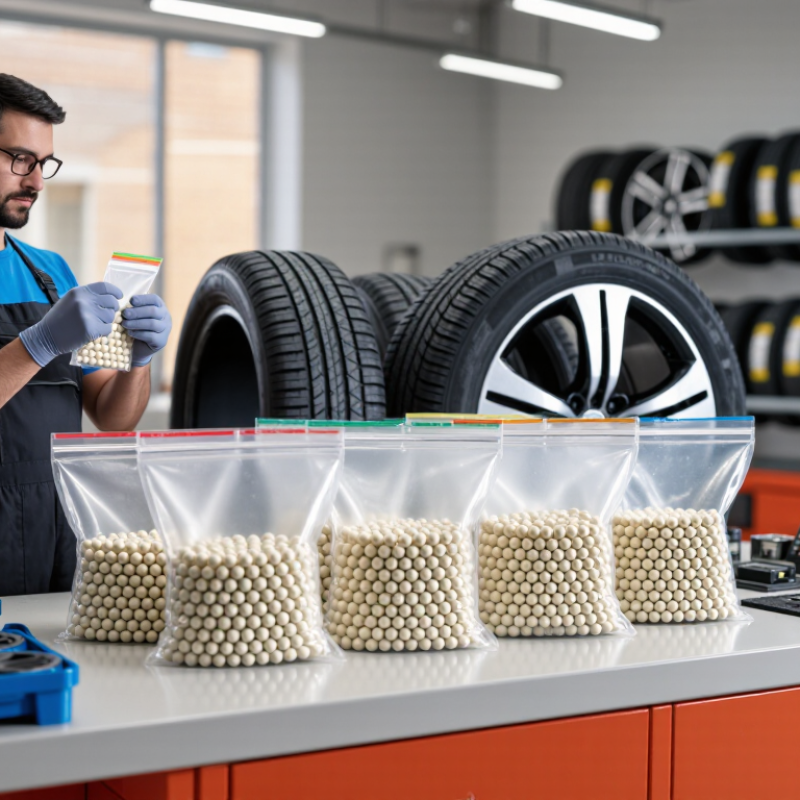
For global buyers of tire balance beads, supplier comparison should begin with the product specification, not the lowest quote. Confirm bead material, size range, moisture protection, packaging weight, and batch traceability. Ask for a recent inspection report and a sample packed as it would be shipped. A small pouch may look sturdy on a desk but split after repeated handling. That detail is easy to overlook.

Shipping conditions can change the real cost. UNCTAD’s Review of Maritime Transport 2024 reports that global maritime trade grew 2.4% in 2023, while disruptions around key routes highlighted how quickly schedules can shift. Compare full transit time, port handling, insurance, and destination charges—not just the ocean rate. For urgent replenishment, air freight may reduce delays but raise the cost per kilogram. Sea freight usually suits larger, planned orders. There is no perfect choice.

The World Bank’s Logistics Performance Index 2023 evaluates six areas, including customs, tracking, and timeliness. Use those dimensions to assess a supplier’s shipping plan, then request recent delivery records for your destination. Check whether the quote includes export packing and whether cartons can be palletized. A spreadsheet still cannot show every risk. I would leave room for a buffer; my first shipping estimate would not be the final one.

Checking Installation Guidance and Performance Support

For global buyers, installation guidance matters as much as bead material. Ask suppliers for a written dosage chart matched to tire size, load, and wheel configuration. A generic scoop is not enough. Confirm compatibility with the valve core, TPMS hardware, and any sealant already inside the tire. Installation methods differ. Some systems allow dosing through the valve stem; others require placement during mounting. Never force beads through a restricted valve. Clear instructions can prevent delays at the service bay.

Performance support should explain what to check after installation, not promise a perfect ride. A technician can inspect for air leaks, confirm the valve core is seated, and road-test under normal operating conditions. If vibration remains, check tire condition, rim runout, mounting accuracy, and bead quantity before adding more. More is not automatically better. Request troubleshooting guidance and a contact path for unusual cases, such as low-speed vibration or repeated balance complaints. Keep records of tire size, bead amount, and mileage; these details help support teams investigate problems across markets. Documentation may still be incomplete. Flag that before purchase.