How to Choose Electric Power Substations?
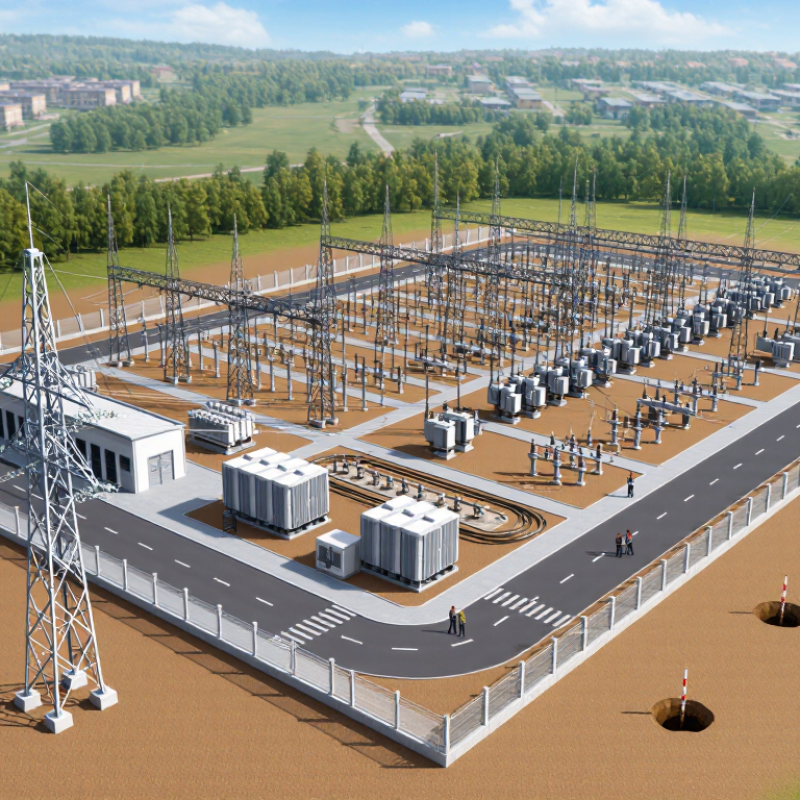
Choosing Electric Power Substations starts with the work the site must perform. A distribution station serving a growing neighborhood has different needs from a transmission hub. Define the voltage levels, expected load, and room for future expansion. Then examine transformer capacity, short-circuit ratings, protection systems, grounding, and access for maintenance. A narrow access road can complicate a transformer replacement years later. Small details matter.
Michael Faraday, a pioneer of electrical science, wrote, “Nothing is too wonderful to be true, if it be consistent with the laws of nature.” His words offer a useful reminder: base design choices on engineering evidence, not assumptions. Compare candidate sites using soil conditions, flood exposure, nearby loads, connection distance, and lifecycle costs. Review applicable technical standards with qualified power-system engineers, and confirm that equipment ratings match the utility’s requirements. No single layout fits every project.
The best choice balances reliability, safety, cost, and adaptability. A compact site may reduce land needs but limit later upgrades. An oversized design can waste money. Honestly, early forecasts are imperfect; load growth can surprise even experienced planners. Use documented assumptions, test more than one growth scenario, and record why key decisions were made. That record helps operators understand the trade-offs long after construction ends.
Assessing Present and Future Electricity Demand
Choosing a substation starts with a careful view of electricity demand today and tomorrow. Review interval-meter data, not just annual consumption. A factory’s Monday morning ramp or a neighborhood’s winter evening peak can shape equipment needs. The IEA’s Electricity 2024 report forecasts global electricity demand growth of about 3.4% annually from 2024 to 2026. It also estimates data-center electricity use could rise from 460 TWh in 2022 to over 1,000 TWh by 2026. These are global signals, not local forecasts. Peaks matter.
Build local scenarios across several time horizons. Include new housing, industrial projects, electric-vehicle charging, rooftop generation, and connections already awaiting service. Compare peak load, power factor, and seasonal patterns with transformer, busbar, and feeder capacity. Leave practical headroom, but avoid sizing solely for a dramatic worst case. The IEA’s 2023 Electricity Grids and Secure Energy Transitions report says about 80 million kilometres of grids may need to be added or refurbished by 2040. That broad estimate underlines the scale of planning, yet it cannot predict one site’s needs. Forecasts can look tidier than reality. Recheck assumptions against actual load data; even a well-built forecast can miss a delayed project or a faster-than-expected demand shift.
How to Choose Electric Power Substations: Assessing Present and Future Electricity Demand
Illustrative peak-demand forecast for substation capacity planning (MW)
The example starts at a 2025 peak demand of 42 MW and compares low-, base-, and high-growth forecasts. Compare projected peak demand with firm substation capacity, allowing for planned maintenance, reserve requirements, and major new loads such as housing or electric-vehicle charging. Replace these illustrative figures with local load data before making planning decisions.
Selecting the Substation Type and Voltage Level
How to Choose Electric Power Substations?
Selecting the Substation Type and Voltage Level
Choosing a substation begins with its role in the network. A transmission substation moves bulk power between high-voltage lines. A distribution substation steps voltage down for neighborhoods, businesses, or industrial sites. Some facilities perform both functions. Keep the purpose clear.
Voltage selection depends on the utility network, expected demand, and the distance power must travel. Higher voltage can reduce transmission losses, but it also requires suitable clearances, insulation, protection, and equipment. A 33/11 kV arrangement may suit some distribution networks, but regional standards and actual load conditions matter more than a familiar example. Check the utility’s requirements early.
The physical site helps determine the substation type. Air-insulated equipment needs more space and careful clearance planning. Gas-insulated equipment can fit tighter sites, though cost, maintenance, and specialist handling deserve attention. A hybrid layout may balance these needs. Consider flooding, salt, dust, access roads, and room for future transformers. Small details matter. Early demand forecasts are rarely perfect; document their assumptions and test more than one growth scenario before fixing the voltage level or layout.
Evaluating Site Conditions and Grid Connectivity
When choosing a site for an electric power substation, check the ground as carefully as the map. Look for stable soil, manageable slopes, reliable drainage, and enough space for equipment, safety clearances, and future expansion. A shallow ditch may seem minor, but after heavy rain it can become a real access problem. Walk the site in wet weather if possible. A desktop map can look convincing. It can still mislead.
Grid connectivity matters just as much. Ask the utility to assess nearby transmission or distribution lines, available capacity, connection routes, and expected fault levels. Confirm whether new line corridors need easements and whether roads can support heavy equipment deliveries. Check how the proposed connection affects voltage performance and protection settings. These studies take time, so include them early in the schedule. One thing is easy to underestimate: a nearby line does not guarantee a simple connection.
Tips: Compare candidate sites using the same checklist. Photograph drainage paths, access points, and overhead line clearances. Record seasonal constraints, too. Early surveys reduce surprises, though they rarely catch every issue. Leave room for revisions; even a careful plan may need another look.
Comparing Equipment, Safety, and Reliability Needs
Choosing an electric power substation starts with the load, not a catalogue. Map present demand, expected growth, voltage levels, and the consequences of losing each feeder. A compact gas-insulated layout can suit a constrained urban site; air-insulated equipment may offer easier visual inspection and access. Neither choice wins everywhere. IEA’s 2023 Electricity Grids and Secure Energy Transitions report says over 80 million kilometres of grids must be added or replaced by 2040. That scale makes future expansion space worth pricing today. A tidy equipment schedule can still miss awkward realities, like a transformer delivery route blocked by a narrow gate.
Safety and reliability deserve equal weight. Check clear working space, grounding, fire separation, drainage, and safe vehicle access; then review switching procedures and protection settings with qualified engineers. Redundant transformers or bus arrangements can limit the impact of a failure, but they add cost and maintenance points. EIA reported that U.S. customers experienced an average 5.5 hours of power interruptions in 2022, including major events. That is a system-wide measure, not a substation score, but it shows why outage consequences matter. Ask whether critical loads need backup supply, whether spare parts are locally available, and how crews can isolate equipment safely. N-1 planning can help, yet it may not cover every common-cause failure. I’d test the design against a real maintenance outage, not just a perfect-day model.
Reviewing Costs, Regulations, and Expansion Potential
A substation’s purchase price is only part of its cost. Compare land, civil works, transformers, switchgear, protection systems, and connection fees. A site with a low asking price may need costly drainage, road access, or soil reinforcement. That adds up. Ask for estimates covering installation, routine maintenance, equipment replacement, and planned outages. Keep assumptions visible; early estimates are rarely exact.
Regulations can affect both schedule and design. Requirements vary by location and may cover utility interconnection, electrical safety, noise, fire protection, and environmental permits. Confirm them with the relevant authorities and qualified engineers before selecting a site. A delayed permit can hold up construction even when equipment is ready. Keep written records of consultations and design changes. Paperwork is practical.
Expansion potential deserves equal attention. Review load forecasts and check whether the site can accommodate another transformer, additional switchgear bays, and larger cable routes. Look for usable land, spare bus capacity, and space for safe maintenance access. For example, an empty equipment pad beside the main transformer may simplify a future upgrade. Yet reserving space also has a cost, and forecasts can be wrong. Compare staged expansion costs with the expense of building more capacity upfront. A tidy spreadsheet won’t capture every constraint; walk the site and test the assumptions.
How to Choose Electric Power Substations? – Reviewing Costs, Regulations, and Expansion Potential
Planning-level comparison. Cost and capacity figures are screening references only; actual values depend on location, scope, utility requirements, site conditions, and procurement date.
| Decision factor | What to evaluate | Planning data or benchmark | Practical selection guidance |
|---|---|---|---|
| Voltage and network role | Identify whether the site serves transmission, sub-transmission, distribution, or a customer facility. | Common sub-transmission and distribution levels include 11, 13.8, 22, 33, and 69 kV; transmission levels vary by country and grid. | Confirm the utility’s standard nominal voltages, insulation levels, and connection requirements before selecting equipment. |
| Load and transformer capacity | Estimate peak demand, load growth, power factor, contingency needs, and the consequences of losing one transformer. | Transformer ratings are selected to suit the network and are available in a wide range; there is no universal capacity that defines a distribution or transmission substation. | Model normal and contingency conditions. Check whether the design can maintain required service after the loss of a major component. |
| Capital cost | Compare land, civil works, transformers, switchgear, protection and control, interconnection, and commissioning costs. | Costs are highly site- and scope-specific. Brownfield upgrades, remote locations, difficult ground conditions, and major transmission connections can materially increase project cost. | Request comparable, scope-based estimates and include owner’s costs, contingencies, taxes, escalation, and decommissioning where applicable. |
| AIS versus GIS layout | Compare air-insulated switchgear (AIS) and gas-insulated switchgear (GIS) for space, environment, access, and maintenance. | AIS generally needs more clearance and land. GIS can reduce the switchyard footprint but may have higher equipment cost and specialized maintenance needs. | Evaluate total life-cycle cost, site constraints, outage access, and applicable rules for insulating gases—not just initial equipment price. |
| Reliability and redundancy | Review bus configuration, breaker arrangement, transformer redundancy, protection coordination, and restoration plans. | A single-bus arrangement is generally simpler; sectionalized, ring-bus, or breaker-and-a-half arrangements can provide more operating flexibility but add equipment and complexity. | Choose the arrangement based on required reliability, fault exposure, switching practices, and the cost of interrupted service. |
| Expansion potential | Check space for future bays, transformers, cable routes, access roads, and control-room equipment. | Future expansion can be constrained by property boundaries, easements, clearances, environmental buffers, and the arrangement of existing equipment. | Reserve land and establish a staged single-line diagram early; verify that initial construction will not block planned additions. |
| Permitting and land use | Assess zoning, planning approval, environmental review, noise, drainage, visual effects, and community consultation. | Requirements depend on the country, state or province, local authority, project type, and whether new transmission lines or other facilities are included. | Engage relevant authorities and the connecting utility during site screening; permitting and land acquisition can affect both schedule and cost. |
| Electrical and safety standards | Verify design requirements for insulation coordination, grounding, short-circuit duty, clearances, arc-flash risk, and equipment testing. | Potential references include IEC 61936-1 for power installations above 1 kV AC, IEC 62271 series for high-voltage switchgear, IEEE Std 80 for substation grounding, and locally adopted electrical codes. | Confirm which standards and editions are adopted by the authority having jurisdiction and the utility; standards do not replace local code requirements. |
| Grid connection and compliance | Determine interconnection studies, protection settings, metering, communications, and operating requirements. | In the United States, applicable requirements may include FERC-jurisdictional rules, NERC reliability standards where applicable, and regional or utility interconnection requirements. | Establish the responsible grid operator and applicable compliance framework at project start; requirements differ across jurisdictions and project types. |
| Environmental and climate resilience | Review flood, wildfire, seismic, wind, icing, heat, contamination, and oil-containment risks. | Site-specific hazard maps and engineering studies should inform design elevations, drainage, equipment ratings, fire protection, and spill-control measures. | Select a site and equipment ratings that account for current hazards and expected service life, then document mitigation and emergency plans. |
| Operations and life-cycle cost | Compare inspection, maintenance, spare-parts, outage, staffing, and replacement requirements. | Life-cycle cost depends on equipment design, duty, environment, labor, and outage constraints; purchase price alone does not capture operating cost. | Evaluate the full life-cycle cost and ensure maintainers can access equipment safely without unacceptable service interruptions. |
Note: The standards and regulatory references above are examples, not a complete compliance checklist. Confirm current local requirements with the authority having jurisdiction, utility, and qualified engineering professionals.
English
Česká republika
Deutsch
Dutch
Polska