 English
 Česká republika
 Deutsch
 Dutch
 Polska



How to Choose the Right Multi Adapter Wiper Blade?
Choosing the right multi-adapter wiper blade is about more than finding a blade that looks similar to your old one. Your vehicle’s wiper arm needs a compatible connector, and small differences can affect how securely the blade locks in place. A Multi Adapterwiper may include several fittings, but that does not guarantee it suits every vehicle. Check your owner’s manual or a reliable vehicle fitment guide before buying.
Begin with the vehicle’s make, model, and year, then confirm the wiper lengths for both sides. Measure the existing blades if needed, but treat that measurement as a cross-check rather than the only source. Small parts matter. Look closely at the arm connection, such as a hook, pin, or top-lock style, and compare it with the adapters supplied. A fitting that nearly matches is not a safe match.
Blade design also affects visibility and performance. Beam blades sit close to the glass, while conventional frames have visible support brackets. Either style can work well when correctly fitted and suited to your driving conditions. Consider frequent rain, snow, or dusty roads, and check the manufacturer’s stated materials and fitment details. After installation, tug gently on the blade and test it with washer fluid. Check twice. If the connector feels loose or the blade skips across the glass, stop and recheck the fit. Even careful research can miss a detail; vehicle-specific confirmation is worth the extra minute.
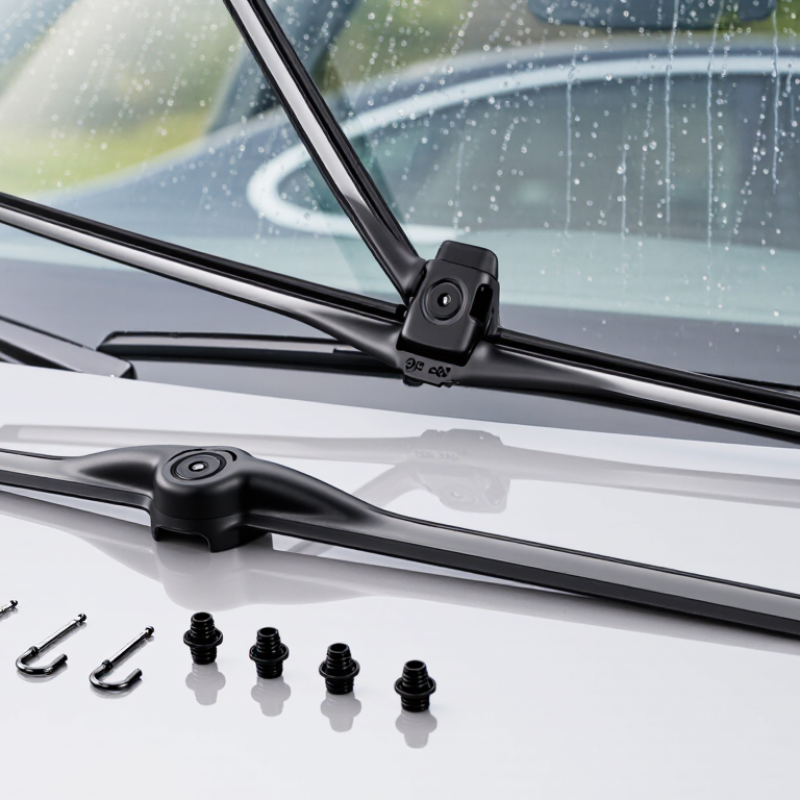
Understanding Multi-Adapter Wiper Blades and Their Connector Types
Multi-adapter wiper blades use interchangeable fittings to connect one blade design to different wiper-arm styles. Common connectors include J-hook, bayonet, side-pin, pinch-tab, and top-lock. They may look similar in a product photo, but their locking points and release methods differ. A J-hook curves around the blade’s adapter; a side-pin arm needs a matching opening. Small, but critical. Check the vehicle manual or measure the arm before choosing a blade. A fitting that clicks into place may still sit crooked or leave the blade loose.
Compatibility matters across an aging vehicle fleet. S&P Global Mobility reported that the average age of U.S. light vehicles reached 12.6 years in 2024. That figure does not count connector types, but it highlights why older vehicles may need careful fit checks. SAE J903 addresses windshield-wiper system performance; it should not be treated as a universal adapter-fit guide. Compare the arm shape, connector dimensions, and adapter instructions, then gently tug the installed blade to confirm it is locked. One awkward detail: adapters can be easy to confuse when viewed from above. Inspect the connection from the side, and test the blade on a wet windshield before driving.
How to Choose the Right Multi Adapter Wiper Blade? — Understanding Multi-Adapter Wiper Blades and Their Connector Types
| Connector Type | How It Attaches | Common Identification Clues | What to Check on a Multi-Adapter Blade | Fitment Tip |
|---|---|---|---|---|
| J-Hook (U-Hook) | The curved end of the wiper arm passes through the blade connector and hooks into a locking point. | The arm end curves back on itself, forming a J- or U-shaped hook. Common sizes include 9 × 3 mm and 9 × 4 mm, but dimensions should be verified. | Confirm the adapter has a channel wide and tall enough for the arm, plus a secure locking cover or tab. | Slide the arm fully into the connector until it locks. Pull gently on the blade to confirm it is secured. |
| Pinch Tab | Two small tabs on the sides of the wiper arm are squeezed to release or secure the blade. | The arm has side tabs near its end rather than a curved hook. The exact tab position and arm dimensions vary by vehicle. | Look for an adapter with accessible release points and enough clearance for the arm tabs to engage. | Check that both sides lock evenly; a blade that only partly engages may detach during use. |
| Top Lock / Push Button | The arm slides into the blade connector and locks with a button or catch on top. | The arm end is generally flat or rectangular, with a button, slot, or locking feature on its upper surface. | Match the adapter’s width and locking position to the arm. Similar-looking top-lock systems are not always interchangeable. | Press the release button as directed when removing the old blade; do not force the connector sideways. |
| Side Pin | A pin projecting from the side of the arm fits into a hole or slot in the blade connector. | A short cylindrical pin is visible on one side of the arm. Pin diameter and distance from the arm end can differ. | Verify that the adapter opening aligns with the pin and that the connector accommodates the arm width. | Make sure the pin is fully seated in the adapter opening and that the blade cannot slide off the arm. |
| Bayonet / Side-Mount Arm | A narrow, straight arm end enters a matching slot and is retained by a clip or locking feature. | The arm is typically straight and flat, without a J-hook; its end may have a notch or cutout. | Compare the arm thickness, width, and end shape with the included adapter instructions. | Confirm the blade sits straight on the arm and the locking feature is fully engaged before operating the wipers. |
| Multi-Adapter Blade Assembly | One blade package includes interchangeable or pre-installed adapters for several arm styles. | The package lists supported connector types or shows adapter pieces with distinct shapes. | Check that the correct adapter is included, fits securely, and is installed in the orientation specified by the instructions. | Use the vehicle’s year, make, model, and wiper position to confirm fit. Driver-side and passenger-side blades may differ in length. |
Before buying: Identify the arm connector and confirm the required blade length for each wiper position. Connector appearance and dimensions can vary, so consult the vehicle owner’s manual or a reliable fitment guide, and test that the installed blade locks securely before driving.