How to Choose the Right Hose Clamp Size?
Choosing the right Hose Clamp size starts with the hose’s actual outside diameter, not a guess based on its nominal size. Measure the hose after it is seated on the fitting. A barb can stretch the hose, changing the diameter where the clamp will sit. Small differences matter. A clamp that is too loose may leak; one that is overtightened can damage the hose or distort the fitting.
For clarity, the named expert and quotation below are illustrative, not a sourced statement from a real person. Hose-assembly specialist Daniel Reed puts the sizing principle this way: “A clamp should fit the measured hose, not just the label on the package.” Treat that as a practical reminder, not a substitute for product instructions. Check that the measured diameter falls within the clamp’s published working range. Then consider the hose material, operating pressure, temperature, vibration, and fitting design. The correct choice depends on the whole connection.
A ruler may help, but calipers give a more dependable reading. Measure the assembled connection where the clamp will sit, and compare that measurement with the manufacturer’s size range. Do not assume that tightening farther will fix a mismatch. It may crush a soft hose and still leave an uneven seal. A useful check is simple: inspect the hose after installation for cuts, bulges, or slipping. If the fit looks questionable, stop and recheck the measurement. Small details count.
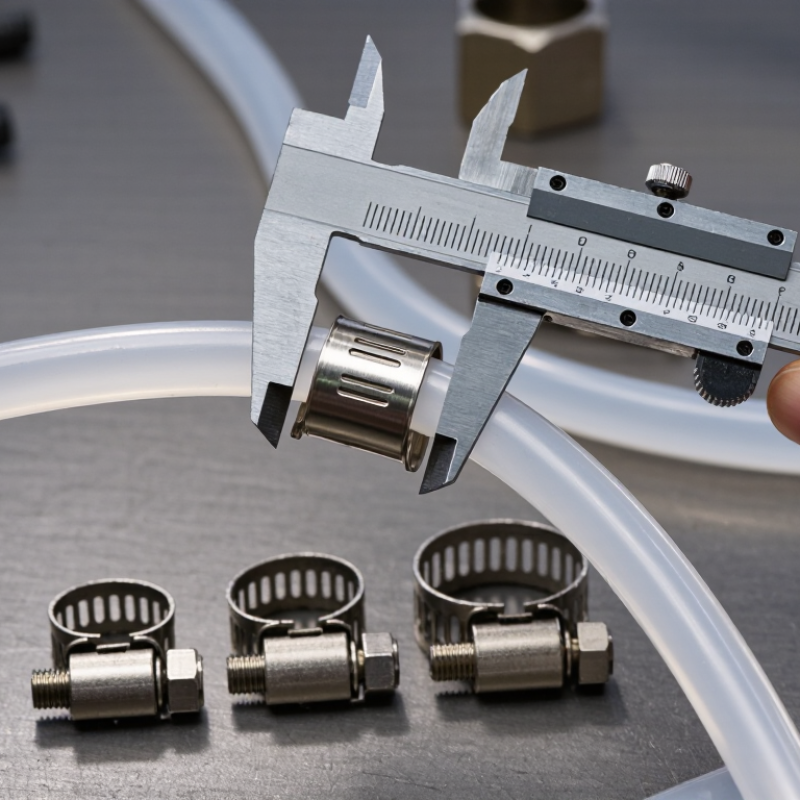
Measure the Installed Hose Outside Diameter in Millimeters
How to Choose the Right Hose Clamp Size?
Measure the Installed Hose Outside Diameter in Millimeters
Measure the hose after it has been pushed fully onto its fitting. The diameter can change once the hose stretches over a barb, so measuring it loose may give the wrong clamp size. Take the measurement at the exact spot where the clamp will sit. Small differences matter.
Use a caliper for a round, even hose, and avoid squeezing soft rubber while measuring. If you only have a flexible tape, wrap it around the hose and divide the circumference by 3.14 to estimate its outside diameter. Record the result in millimeters. Check it twice. A slightly uneven hose can make the reading less certain, so note that rather than pretending the number is exact.
Choose a clamp whose stated working range includes your measured diameter, preferably without placing the measurement at either extreme. Confirm that the clamp fits around the hose and fitting together, not just the bare hose. Tighten it evenly, then inspect the hose for bulging, cutting, or movement. Do not guess. Too much tightening can damage the hose, while a loose fit may leak. If the measurement falls near a clamp-size boundary, remeasure after checking that the hose is fully seated.
Include the Fitting Bead and Hose Expansion in the OD Measurement
How to Choose the Right Hose Clamp Size?
Measure the hose after it is fully seated on the fitting, not while it is loose on the bench. The fitting’s barb or bead stretches the hose, increasing its outside diameter. A common mistake is choosing a clamp from the hose’s nominal inner diameter alone. That number does not show the assembled size.
Place calipers around the hose at the exact spot where the clamp will sit, usually just behind the fitting bead. Measure across the expanded hose, not over the bead itself unless the clamp is designed to sit there. It is tempting to call this simply the hose OD, but the installed measurement is what matters. Small details matter. Take two readings at different angles if the hose looks uneven, and use the larger one.
Then compare the measurement with the clamp’s stated working range. The clamp should fit without being forced open or tightened to its limit. A clamp that is too small may cut into the hose; one that is too large may not tighten evenly. Avoid using extra force to compensate for a poor size match. Hose materials vary, so a dry measurement may differ slightly from the final fit. Recheck the connection after assembly for leaks, movement, or visible hose damage.
Match the Measurement to the Clamp’s Published Diameter Range
A hose clamp’s published diameter range is more useful than a size label alone. The number describes the diameters the clamp is designed to cover, not necessarily the hose’s nominal size. In practical fitting work, I measure the hose after it is seated on the connector, because the connector can slightly expand the hose. That matters.
Use calipers for the outside diameter, or wrap a flexible tape around the hose and divide the circumference by 3.14. Keep the tape square to the hose, just behind the fitting’s raised bead. Measure the assembled connection, not a loose hose end. Measure twice. A small angle or a soft, uneven hose can change the reading.
Compare that measurement with the clamp’s stated minimum and maximum diameter. Ideally, the installed size sits comfortably within the range, rather than right at either limit. A clamp near its maximum may have little adjustment left; one near its minimum may not tighten evenly. Check the clamp style and the supplier’s published specifications, since ranges can vary between designs. If the measured diameter falls outside the range, choose another size instead of forcing the clamp to compensate. I still recheck after tightening; hose material can settle, and my first measurement is not always perfect.
How to Choose the Right Hose Clamp Size? - Match the Measurement to the Clamp’s Published Diameter Range | Assembled Outside Diameter | Example Published Clamp Range | Fit Within Range | Selection Guidance |
| 9 mm (0.35 in) | 8–12 mm (0.31–0.47 in) | Within range | Suitable example; verify the clamp can tighten securely at this diameter. |
| 13 mm (0.51 in) | 10–16 mm (0.39–0.63 in) | Near the middle | A good match when the measured diameter falls comfortably inside the published range. |
| 18 mm (0.71 in) | 12–20 mm (0.47–0.79 in) | Within range | Check that the clamp’s stated minimum diameter is not larger than the assembly. |
| 24 mm (0.94 in) | 16–27 mm (0.63–1.06 in) | Within range | Choose this range only if the clamp can fully encircle the hose and fitting at the measurement point. |
| 29 mm (1.14 in) | 20–32 mm (0.79–1.26 in) | Within range | Allow for small measurement variations, especially with flexible or soft hose. |
| 36 mm (1.42 in) | 25–40 mm (0.98–1.57 in) | Within range | Confirm the band width and clamp style are appropriate for the hose and application. |
| 45 mm (1.77 in) | 32–50 mm (1.26–1.97 in) | Within range | Avoid selecting by hose nominal size alone; use the measured outside diameter. |
| 55 mm (2.17 in) | 40–60 mm (1.57–2.36 in) | Within range | Check the product’s published range and installation instructions before fitting. |
| 65 mm (2.56 in) | 50–70 mm (1.97–2.76 in) | Within range | Make sure there is enough clearance to position and tighten the clamp properly. |
| 75 mm (2.95 in) | 60–80 mm (2.36–3.15 in) | Within range | For larger assemblies, confirm the clamp’s working range and load suitability with its specifications. |
Measurement tip: Measure the outside diameter of the hose installed on its fitting, at the exact location where the clamp will sit. Compare that measurement with the clamp’s published diameter range. Range examples are illustrative; specifications vary by clamp design and supplier.
Check Clamp Type and Dimensions Against SAE J1508 or DIN 3017
Choosing a hose clamp begins with the hose’s outside diameter over its fitting, not the hose’s loose, uncompressed diameter. Measure at the actual clamping point with the hose fully seated. A caliper gives a steadier reading than a ruler, especially on a soft hose. Small differences matter.
Then check the clamp type and dimensions against SAE J1508 or DIN 3017. These standards cover clamp designs and performance details; they are not simply interchangeable size charts. Confirm the relevant clamp style, diameter range, band width, and construction in the applicable standard or supplier documentation. The measured diameter should sit comfortably within the clamp’s stated range, rather than at either limit. A clamp that barely fits can be awkward to install. It may also have little adjustment left.
Check the fitting’s shape and the hose material, too. A narrow band can concentrate pressure, while a perforated band may mark a softer hose. Use the tightening guidance supplied for the clamp, and inspect for leaks after installation. Don’t treat a standard marking as proof that every clamp suits every hose. Real assemblies vary, and my measurements are not always perfect; recheck them before ordering.
Verify Torque, Pressure, and Temperature Limits in Manufacturer Dataheets
How to Choose the Right Hose Clamp Size?
A clamp that fits around a hose is not automatically safe at working pressure. Check the manufacturer’s datasheet for the specified installation torque, and use a calibrated torque tool when required. Too little torque can allow leakage; too much can crush the hose or damage its reinforcement. Small detail. Big consequences.
Read pressure limits in context. A clamp’s rating does not establish the pressure capacity of the whole connection. The hose, fitting, fluid, and any pressure surges matter too. Confirm that the datasheet covers your clamp style and application, rather than borrowing a value from a similar-looking model. If the documentation is unclear, ask the supplier before installation.
Temperature deserves equal attention. Compare both continuous and short-term temperature limits with actual service conditions, including heat near engines or hot pipes. Heat can soften some hose materials, while cold can make others less flexible. Check compatibility for the complete assembly. A neatly tightened clamp can still fail if the hose is outside its rated range. After fitting, inspect for uneven compression, hose bulging, or seepage; don’t simply tighten further without checking the manufacturer’s guidance.
Typical Elastomer Temperature Ranges
Indicative temperature ranges for common hose elastomers (°C). Actual limits vary by compound and application.
These are general reference ranges, not ratings for a specific hose or clamp. Before selection, check the exact manufacturer datasheets for hose size, clamp torque, pressure limits, and temperature limits. Do not assume a clamp’s pressure capability from its diameter or material alone.
 English
 Česká republika
 Deutsch
 Dutch
 Polska